

Bachelor of Arts in History

ABOUT THE DEPARTMENT
The Department of History at the University of Maryland embraces the diversity of the human past with a global vision and wide-ranging methods of inquiry. Accomplished faculty specialize in cultures from all over the world and are subject matter experts in historical eras stretching from antiquity to the modern era. Small class sizes provide ample opportunities for mentorship and hands-on learning. Undergraduates are encouraged to explore academic publishing, engage in independent research and participate in internships.
COURSEWORK
History coursework is robust yet flexible and expansive. Majors are encouraged to build a unique academic journey tailored to their research interests and career goals. Students conclude the major with a small-sized capstone seminar focused on historical argument or original research. Majors can benefit from experiential learning and the additional opportunities that come from the university's close collaborations with nearby D.C. cultural institutions, including museums, libraries and archival collections. Students can explore course offerings in the digital humanities and participate in oral history projects and relevant study abroad courses that provide an immersive experience.
Career Readiness
The College of Arts and Humanities (ARHU) offers courses designed to ensure students are ready to enter the workforce, along with integrated and individualized academic and career advising. Alumni continue on to graduate school or forge their careers in a variety of industries and fields. The creative ways to apply your ARHU degree are truly limitless! Here are some placements specific to Historymajors:
Internship Placements
- Baltimore Museum of Industry
- Dickinson Archives
- International Spy Museum
- White House Historical Association
Graduate School Placements
- Columbia Law School
- Emory University
- Georgetown University
- Oxford University
Employer Placements
- Booz Allen Hamilton
- Library of Congress
- National Children's Museum
- National Park Service
- Pennsylvania State Archives
The History Major
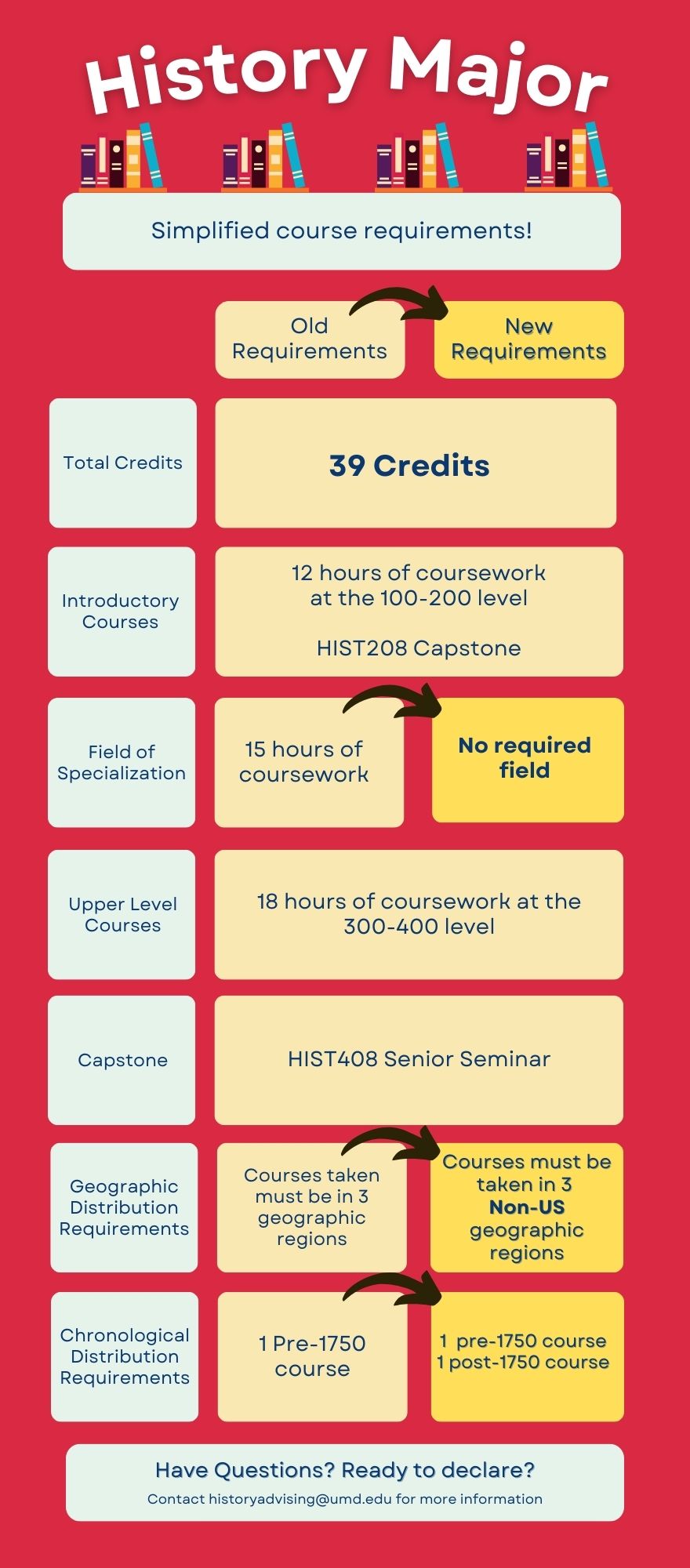
The History Major encourages students to engage in more diverse and expansive learning while removing the supporting course requirements. The Department of History seeks to broaden the students' cultural background through the study of history and to prepare those interested in publishing, teaching, museum work, law, journalism, civil service, military service, archival and library work, diplomacy, business school, graduate study and many more career opportunities.
Program learning outcomes include:
- Students will be able to distinguish among a variety of genres of primary and secondary historical sources (e.g. documents, monographs, letters, novels, film, political cartoons, essays, artifacts) and use them appropriately and effectively in academic work.
- Students will demonstrate the ability to conduct research using primary and secondary sources including archival, print and non-print, and web-based texts.
- Students will demonstrate the ability to define and defend a historical thesis.
About the History Major
Introductory Courses
The requirement for Introductory Courses is 12 hours of History courses at the 100-200 level.
One of these courses must be HIST 208.
In considering courses that will fulfill this requirement, students are encouraged to:
• select at least two courses in a sequence (e.g. HIST 234, HIST 235, HIST 236);
• select at least one course covering history before 1500 and one course covering history after 1500;
• sample both regional and topical course offerings.
Students will normally take one or more introductory courses within the major field of specialization.
Capstone
The History Major Capstone Seminar, HIST 408, will be taken in the junior or senior year and may be inside or outside the field of specialization.
Distribution Requirements
Students must take courses in at least three geographical regions.
At least two courses must be taken in two or more of the following fields:
- Africa and the African Diaspora
- Latin America and the Caribbean
- North Africa, Middle East, and Central Asia
- South and East Asia
- Select GIE courses approved by the Undergraduate Committee
Students must take at least one course covering history in the pre-1750 period.
Requirements (2022-2024)
Requirements for the History Majors noted above are 39 credit hours of History coursework distributed as follows:
- 12 hours in 100-200 level introductory courses and including HIST 208
- 15 hours in one major field of specialization (see below)
- 9 hours of history in at least two major fields other than the field of specialization
- Capstone Seminar: HIST 408
- Students must also meet distribution requirements (see below)
- All courses for the history major must be completed with a minimum grade of C-
- 21 credit hours of the 39 total credit hours must be at the 300-400 (junior-senior) level
- No more than 6 credit hours (2 courses) can be fulfilled by AP or IB credit
History majors can petition to include up to 2 courses taught outside the Department toward the fulfillment of the major, with the approval of the Undergraduate Committee. Courses taught outside of the History Department may fulfill geographic and/or thematic requirements. They may not be used to fulfill the Departmental capstone seminars.
