

Meet Environmental Historian Jayson Maurice Porter
February 06, 2026
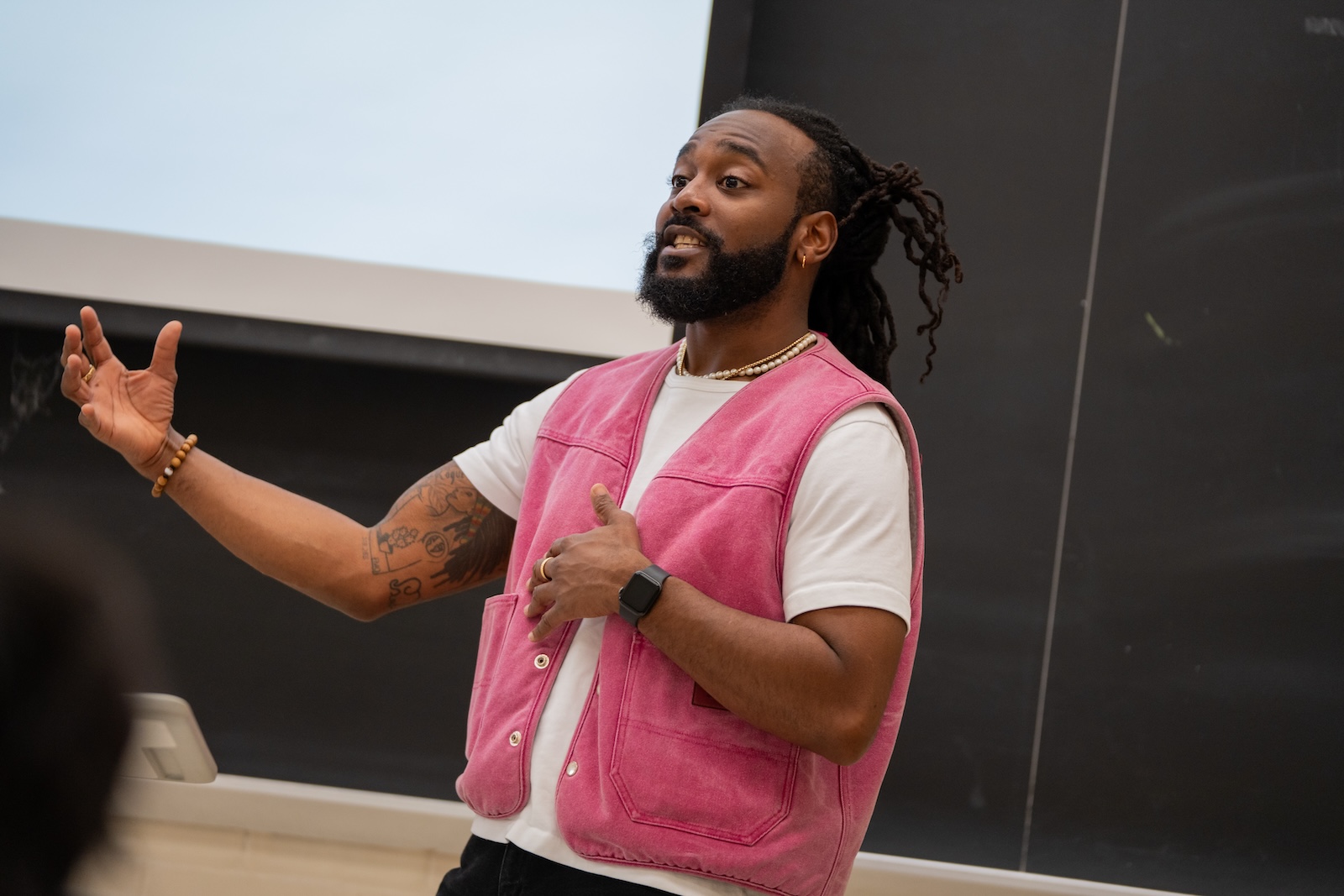
The assistant professor of history reflects on his research, teaching and the CEDAR Gallery, a student-centered space he is developing at UMD.
By Jessica Weiss ’05
Long before ever taking a class on environmental issues, Jayson Maurice Porter learned a valuable lesson about nature after getting a 72-gallon saltwater fish tank as a teenager. As he tracked pH and salinity, he came to see how the water chemistry, light, rock and living creatures all intermingled—and how even a tiny change to one of those elements could shift the entire ecosystem.
It was an early education in interconnectedness, one he’d return to in his work as a historian focused on environment and justice.
Now an assistant professor of history at the University of Maryland, Porter’s research spans the environmental histories of Mexico and the African Diaspora, food systems, agrochemicals and environmental justice and injustice. His writing moves between academic and public audiences, appearing in scholarly journals as well as outlets like The Washington Post and Distillations Magazine. He has been showcased as a public thinker by Public Books.
Porter’s path reflects his interdisciplinary reach. After receiving bachelor’s degrees in history and philosophy, and a minor in environmental sciences, he earned a master’s degree in Latin American history from the University of Oklahoma before completing his Ph.D. in environmental history at Northwestern University, where he was part of the Latin American and Caribbean Studies Graduate Cluster and a Fulbright fellow in Mexico City. Alongside his academic training, Porter has long been engaged in community-based work, designing educational programs for children, working with youth and educators and collaborating with artists and organizers.
At UMD, Porter teaches ecological literacy, environmental justice history, and Afro-Indigenous ecologies of race and resistance in Latin America and the tropics. He’s also preparing to launch the CEDAR Gallery, a faculty- and student-led environmental space in Taliaferro Hall envisioned as both exhibition and gathering place. The CEDAR gallery name is based on its focus, which “centers ecologies, diasporas, and ancestral roots.” It aims to support student wellbeing, highlight environmental work and strengthen interdisciplinary learning through art, activism and scholarship.
We recently spoke to Porter about how he came to environmental history, how certain places have shaped his questions and why CEDAR is so essential at this moment.
The sub-field of environmental history is relatively new. How do you describe what the field allows you to see or ask that other approaches don’t?
A lot of how we understand the environment is through concepts that can feel abstract. Like, say, a nitrogen cycle. But all processes unfold over time. They have conditions. They have consequences. For me, history is one of the most fundamental ways to communicate those things, because it lets you show how something came to be and what it changed. Yes, nitrogen is something that exists in the atmosphere, but it takes time for that to actually become available for plants that can't take it out of the air. Environmental history helps people understand that what we’re living with now didn’t just appear—it emerged from specific choices, structures and timelines.
You were born in Maryland and claim Philadelphia, but spent your formative years in Tucson, Arizona, and Jackson, Mississippi. How did moving between those environments shape the questions you ask now?
Tucson was a place where you had to be aware of your surroundings in very real ways—what could harm you, what sustained you, who was most exposed to risk. Tucson demanded a kind of humility. There are things there that can actually really hurt you, like rattlesnakes, scorpions, coyotes. You couldn’t move through the landscape carelessly.
Jackson shaped me differently. It’s where I spent a lot of time working with the community—doing food justice work, working with youth, thinking seriously about education and care.
Both places made me want to better understand food systems and agricultural labor and how environmental harm follows certain people and places. Over time, that turned into a desire to understand those experiences historically: who bears the cost, who benefits and how those patterns repeat.
Before becoming a professor, you did extensive work with youth and community organizations. How did that shape you?
I spent years designing curricula, facilitating literacy programs and creating spaces where curiosity and imagination were taken seriously. I also developed a philosophy for children program because I saw how deeply kids were already thinking about the world. That work sharpened my writing and teaching. It made me care deeply about accessibility—not just in terms of language, but in terms of who feels invited into a conversation. That still shapes how I think about teaching today.
When you teach environmental justice and environmental racism, what are you noticing in students right now?
Learning about environmental justice, environmental racism and how power shapes environmental experience can be clarifying, but it’s also heavy. You can see it on students’ faces when they realize how deeply environmental harm is tied to things like their zip code or family history. I’ve had students recognize their own lives in the material, learning, for example, that part of Maryland was used for testing chemical weapons, and realizing they grew up there.
Did the idea for the CEDAR Gallery grow out of those classroom experiences?
Definitely. If students are experiencing anxiety or depression while learning about things they care deeply about, how do we support them through that? I’m in the business of tough conversations, but I don’t want to have them and then leave students to deal with the weight of that knowledge on their own. CEDAR is meant to be a gathering space as much as a gallery—a place where students can come together, decompress, make things and connect across disciplines.
What sorts of activities are you planning at CEDAR?
The space should be up and running by April. We’re planning panel discussions, art engagement gatherings, collaborations with student groups and faculty across disciplines, and regular exhibitions. What’s been exciting is that even in these early stages, students are already taking ownership—imagining how the space should work, documenting it and shaping what it becomes.
Your current book project traces environmental history through what you call “oilseed archives.” How did you arrive at that approach?
My research focuses on the role of plants as witnesses to the African Diaspora in Guerrero, Mexico, and I do that by following oilseeds, or the seeds of plants used to extract oil—like cotton, sesame, coconut and later marijuana and opium. These crops were central to the industrialization of agriculture and they allow me to talk about structural conditions: exposure to violence, labor exploitation and environmental harm. Instead of starting with organized crime or contemporary violence, I look at the longer history of economic development and the boom-and-bust cycles of these crops. That history tells a very different story.
Learn more about the CEDAR Gallery and follow along on Instagram.
Photo by Taneen Momeni.